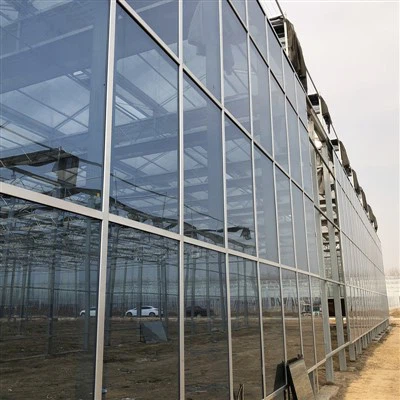
As modern agricultural technologies continue to improve, soilless vertical growing in vegetable greenhouses has become a widely used practice in protected agriculture. It is highly efficient, environmentally friendly, and saves land, which makes it far more advantageous than traditional soil farming. This method not only overcomes many limitations of conventional planting, but also greatly improves vegetable quality and planting returns.
In this guide, we explain the key operating procedures in four practical sections: cultivation preparation, equipment installation, nutrient solution management, and planting performance, to provide hands-on reference for farmers and growers.
1. Building Cultivation Troughs – The Base of Healthy Crop Growth
Taking cherry tomatoes as an example, we use a simple and effective trough system: excavated trenches lined with plastic film.
Trench excavation
We plant in wide-narrow rows, with row spacing set at 60–70 cm. Single-row triangular cultivation troughs are dug, with a 20 cm top width and 25 cm depth. The bottom must be leveled smoothly to avoid local water buildup, which can easily lead to root rot.
Anti-seepage treatment
A layer of plastic film is laid inside the trough to separate the substrate from soil and prevent water leakage.
Substrate filling and transplanting
We fill the troughs with fermented and decomposed straw as the growing medium. After filling, we gently step on the substrate to ensure suitable compactness.Cherry tomato seedlings are then transplanted at a plant spacing of 35 cm to allow enough room for growth.
2. Drip Irrigation System – The Key to Accurate Water & Fertilizer Supply
The drip irrigation system is the core part of soilless culture, as it delivers water and inorganic nutrients directly to the roots. Its layout directly affects growth efficiency and must be planned properly.
Main equipment components
Power supply: We choose equipment based on local conditions. In areas with shallow groundwater, one plastic hose well with a self-priming pump per greenhouse is sufficient. Water towers or variable-frequency pumps for centralized water supply also work well.
Auxiliary parts: These include specially designed fertilizer tanks (to reduce pressure loss and prevent clogging), filters, water meters, 32–40 mm polyethylene branch pipes, and capillary tubes with drippers spaced 20 cm apart. Closer dripper spacing creates more wet areas in the substrate, helping roots absorb nutrients more easily.
Pipeline installation tips
Branch pipes are laid parallel to the back wall of the greenhouse. We usually disconnect them in the middle and connect to the fertilizer tank using a tee, so water flows evenly from the center to both ends.
One capillary tube is placed along each cultivation trough, positioned in the middle with drippers facing upward to reduce clogging.
3. Nutrient Solution Management – Apply on Demand to Increase Efficiency
Unlike the common method of mixing all macro and micro nutrients together, this system uses separate, grouped application to avoid chemical precipitation caused by alkaline groundwater often found in northern regions.
How to apply nutrients
Fertilizers that tend to precipitate are stored separately. During irrigation, we add one group of fertilizer into the tank first. After it fully dissolves and penetrates the substrate, we pause briefly, then add the second group until irrigation is finished.
Water and fertilizer scheduling by growth stage
Early stage (first 10 days after transplanting): Seedlings have shallow roots, so direct drip irrigation may cause waste. Instead, we apply fertilizer manually. NPK fertilizers are dissolved in water at about 1g/L, and poured around seedlings once per day.
Young seedling stage: Water and fertilizer consumption is low. We apply about 0.5 cubic meters per day, split into morning and afternoon sessions, adding one group of fertilizer each time.
Autumn and winter: Irrigation is adjusted based on plant health and weather. We normally use around 1 cubic meter per day, applying only in the morning on sunny days and skipping on cloudy days. The actual amount can be judged by observing moisture accumulation in the troughs.
Spring: As temperatures rise and light strengthens, tomatoes grow quickly. Daily drip irrigation is increased to 1.5–2 cubic meters.
4. Planting Performance – Better Quality & Higher Profits
Compared with traditional soil planting, cherry tomatoes grown with soilless vertical culture show clear improvements:
Improved quality: Sugar content increases by 26.3%, with a pure, balanced sweet-sour flavor and better texture.
Safer and greener: Pesticide use is reduced to only one‑quarter of soil planting, lowering residue risks significantly.
Lower input: Each greenhouse uses around 150 cubic meters of water, with fertilizer costs of about 1,500 yuan – roughly 350 yuan less than soil culture.
Higher profits: While total yield is similar, overall economic returns increase by more than 20%, with obvious economic and environmental benefits.