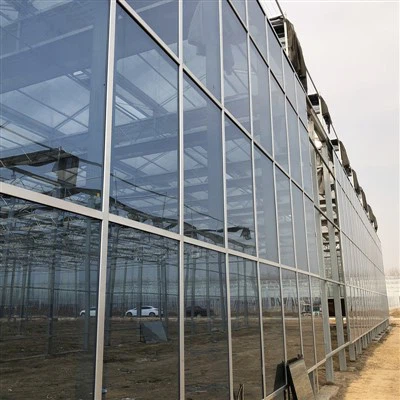
I. Core Advantages: Precision, Efficiency and Sustainability
1. Long Service Life & Stable Growing Conditions
The main structure of the greenhouse is constructed from hot-dip galvanized steel (85μm zinc coating) combined with 6063 high-strength aluminum alloy fittings. It has a service life of 20 to 30 years, much longer than the 5–10 years of traditional plastic greenhouses, greatly cutting long-term replacement costs.
The roof is covered with ultra-white diffuse glass with an original light transmittance of up to 97.5%. An automatic roof cleaning system regularly removes dust and dirt, keeping light transmittance above 90% over time. The diffuse glass design effectively reduces photoinhibition in plants, prevents uneven local light intensity, and creates an optimized, shadow-free growing environment for crops.
2. Breakthroughs in Productivity & Resource Efficiency
Substantial Yield ImprovementTaking tomato cultivation as an example, the annual yield of Dutch-style glass greenhouses reaches 70–80 kg/m², compared with only 10–15 kg/m² in ordinary greenhouses. Under refined management, yields can exceed 120 kg/m² - 6 to 12 times higher than traditional farming methods.
High-Efficiency Resource UtilizationThe intelligent integrated water and fertilizer irrigation system saves 90% more water than traditional flood irrigation, and fertilizer efficiency reaches 95%, reducing nutrient loss and soil pollution. Supported by a closed-loop water system, water consumption is only 3.5 m³ per ton of produce, far below the FAO standard, fully supporting sustainable agricultural development.
3. Full-Scenario Intelligence & Precise Climate Control
The greenhouse is equipped with an IoT central control system linked to over 2,000 distributed sensors that collect and analyze real-time data on temperature, humidity, light and CO₂ concentration. CO₂ levels are stably maintained at 900 μmol/mol, more than three times the natural level, improving photosynthesis and increasing yield by 30%.
Automated equipment replaces manual labor: robots perform pollination, harvesting and sorting, reducing labor costs by 70% while eliminating human error and ensuring consistent product quality.
II. Challenges: Localization Barriers Under High Thresholds
1. High Upfront Investment Beyond Most Users
A complete imported Dutch glass greenhouse costs 1,500–2,000 RMB per square meter. Even with localized improvements, the cost remains 500–800 RMB/m². A standard 10,000 m² greenhouse requires a total investment of 5–8 million RMB - far beyond the reach of average farmers and small cooperatives, limiting wider adoption.
2. Dual Pressure: Energy Costs & Technical Reliance
High Winter Energy ExpensesIn northern China, gas heating is required in winter, accounting for more than 40% of annual operating costs. Without government energy subsidies, most projects struggle to be profitable.
Shortage of Professional TalentDutch glass greenhouses need professional teams to operate automation systems and manage soilless cultivation (rockwool / coco coir). China lacks qualified technical personnel, so actual yields reach only 60% of those in the Netherlands, failing to realize full technical potential.
3. Poor Climate Adaptation to Local Conditions
Dutch greenhouses were originally designed for mild, humid maritime climates. China has diverse climate zones:In Northeast China's continental climate, heat retention is insufficient and extra heating is needed.In hot and humid southern China, summer cooling consumes excessive energy, raising operating costs.This results in poor climate adaptability.
If your project requires high-efficiency greenhouse solutions or you want to learn about the latest applications of greenhouse technology, please contact us.Our team provides full end-to-end support - from solution design and equipment selection to project implementation - customized to your planting needs and site conditions, helping you upgrade agricultural production.We look forward to exploring the future of modern protected agriculture with you.