
If you’ve been around soilless cultivation for any length of time, you know EC is one of the quiet superpowers of healthy plants in a planting trough setup. As a supplier that works with growers large and small, I’ve seen firsthand how even a small, unadjusted EC swing can turn a thriving crop into a series of stunted leaves, bitter fruit, or wasted resources. A planting trough soilless culture system’s entire performance hinges on the delicate balance of nutrients in your solution, and adjusting that EC isn’t just a technical task—it’s the difference between a profitable harvest and a frustrating one.
First, let’s make sure we’re all on the same page: EC, or electrical conductivity, is a measure of how many dissolved salts, minerals, and nutrients are in your water. Soilless culture doesn’t have soil to buffer nutrient levels, so every change you make to the solution directly impacts what your roots absorb. Too low, and plants don’t get enough nitrogen, phosphorus, or micronutrients—think pale leaves, slow growth, or reduced yields. Too high, and roots get “burned”: they lose water through osmosis, leading to wilting even when the solution is moist, and long-term, it can kill off the microbial activity (wait, no—wait, in soilless, it’s mostly the root stress, but the point is, EC mismanagement is a common pain point for beginners and pros alike).
As someone who helps growers select and set up systems, I often see new operators skip consistent EC checks because it feels tedious, or they copy a number from a friend’s garden without considering their own setup. But adjusting EC is specific to your plants, your water source, and your planting trough design. Let’s break this down step by step, with practical tips I’ve learned from years of working with commercial and hobbyist growers.
Start with Baseline EC Testing Before You Even Mix Nutrients
The first mistake I see is growers forgetting to test their source water’s EC. Tap water, well water, or rainwater all have natural salts and minerals that will skew your final solution’s EC. For example, if your well water has an EC of 0.8 mS/cm, and you mix in a nutrient formula that targets a 2.0 mS/cm final EC, you’ll end up with a solution that’s actually 2.8 mS/cm—way too high for most leafy greens or fruiting crops. That’s a quick, avoidable error.
Grab an affordable EC meter (they’re not as expensive as they used to be, even for commercial use) and test your water before adding any nutrients. Write that number down as your baseline. If your water has an EC above 1.0 mS/cm, you might need to dilute it with clean rainwater or reverse osmosis (RO) water, especially for delicate crops like lettuce or herbs. For context, many of our customers who use other soilless setups, like the commercial NFT hydroponic system for leafy greens, often use RO water because it has a very consistent low baseline, making EC adjustments simpler. That said, our planting trough systems work well with slightly higher baseline water, as long as you account for it.
Next, Match Target EC to Your Crop’s Growth Stage
Not all plants have the same EC needs, and even the same plant changes as it grows. Seedlings, for example, need a lower EC to avoid tender root burn—think 0.8 to 1.2 mS/cm for young lettuce, herbs, or tomato seedlings. As plants move to the vegetative growth stage, they can handle a higher EC: 1.2 to 1.8 mS/cm, because they’re putting on lots of leaves and need more nutrients. When plants start flowering or fruiting (like tomatoes, peppers, or cucumbers), that EC can go up even more, to 1.8 to 2.5 mS/cm, because fruit development requires a concentrated dose of minerals.
Here’s where a lot of growers misstep: they pick an EC number and stick to it, no matter the growth stage. I had a customer last year who grew cherry tomatoes in a planting trough soilless culture system, kept the EC at 1.5 mS/cm throughout, and ended up with small, bland fruit. When we adjusted it to 2.2 mS/cm during flowering, their yield jumped 30% and the flavor improved because the nutrients were more concentrated for fruit production. It’s not just about the crop type—it’s about when in its life cycle you are.
Adjusting EC: Two Core Methods, Depending on Your Setup
Once you know your baseline water EC and your target for the current growth stage, you need to adjust the nutrient solution to hit that number. There are two main ways to do this, and which you use depends on whether your planting trough system is a recirculating or run-to-waste setup.
- Recirculating Planting Trough Systems (Most Commercial Setups)
If your system recycles the nutrient solution back to the reservoir, EC can change over time as plants take up nutrients, water evaporates, or salts build up. Evaporation is a big one: when water evaporates from the reservoir, the nutrients stay behind, so EC creeps up. I recommend testing the reservoir’s EC every 2 to 3 days, and checking the pH at the same time (pH and EC go hand in hand, so one off often means the other is, too).
If your EC is too high: You can either top off the reservoir with fresh, low-EC water until the solution dilutes to your target, or partially drain the reservoir (10 to 20% of the volume) and replace it with fresh nutrient solution that hits the correct EC. Top-off is simpler for small systems, but partial draining works better for larger commercial setups to prevent salt buildup over time. For example, a commercial grower with a 1,000-gallon recirculating system might drain 200 gallons every week and replace it with a fresh mix, keeping EC consistent without the risk of old, nutrient-depleted solution building up.

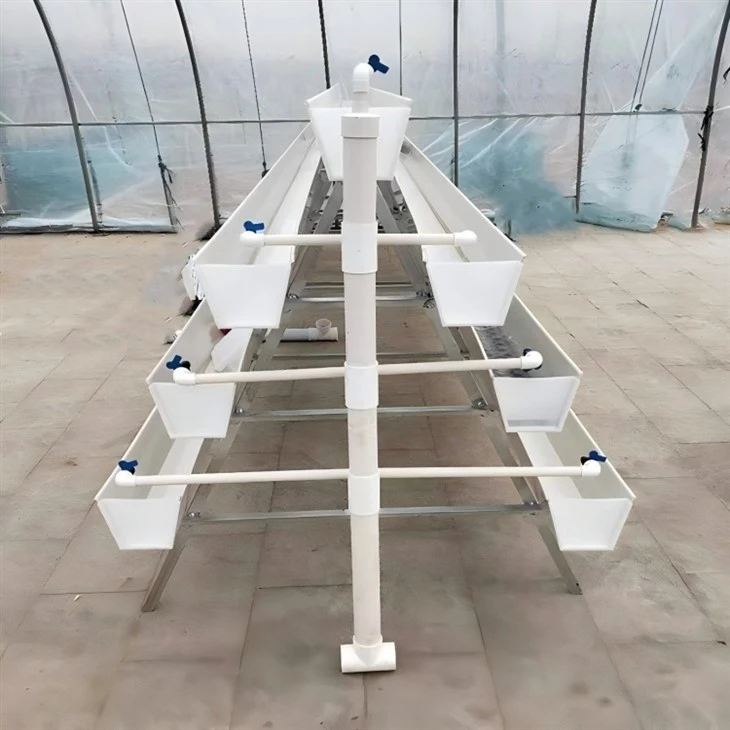
If your EC is too low: You need to add concentrated nutrient solution, not just more dry nutrients. Adding straight dry nutrients to a reservoir that’s already diluted can lead to uneven mixing, which means some areas of the solution have too much of one nutrient and not enough of another. Most commercial growers use two-part nutrient formulas, so you mix a concentrated “A” and “B” stock solution, then add a small amount to the reservoir until you hit your target EC. As a supplier, I always remind customers that our planting trough soilless culture systems work best with two-part formulas because they let you adjust EC precisely without nutrient imbalance.
- Run-to-Waste Planting Trough Systems (Hobbyist or Small-Scale)
In run-to-waste setups, the solution doesn’t recycle—each pass through the planting trough is discarded. This means EC stays more consistent, but you still need to adjust it when you mix a fresh batch. For these systems, I follow a simple formula: (Target EC – Baseline EC) / Nutrient EC = Amount of nutrient to add. For example, if your baseline water is 0.5 mS/cm, your target is 1.8 mS/cm, and your nutrient formula has an EC of 12.0 mS/cm, you’d need to add (1.8 – 0.5) / 12 = ~0.11 liters of concentrated nutrient per liter of water. It’s a bit of math, but once you nail the ratio, it’s easy to replicate every time.
I also want to note that run-to-waste is similar in some ways to substrate culture, another soilless system we supply, where excess solution is drained away to prevent root rot. Many of our customers switch between planting trough and substrate systems depending on their crop, but the EC adjustment logic stays the same across soilless setups.
Common EC Mistakes to Avoid
After working with growers for years, I’ve picked up on a few mistakes that keep coming up, even with experienced operators. The first is ignoring salt buildup in the planting trough itself. Even if your solution’s EC is correct, salts can accumulate in the growing medium (if you’re using a substrate, which is common in planting trough setups) over time, which will push up EC around the roots. Every 4 to 6 weeks, flush your system with low-EC water (0.5 mS/cm or less) to wash away excess salts. For a typical planting trough, you can run 2 to 3 times the volume of water in the trough through to flush, and then drain it out, before refilling with fresh nutrient solution.
Another mistake is testing EC right after adding nutrients, before letting it mix. Nutrients don’t dissolve instantly—wait 15 to 20 minutes after adding them to the reservoir, then stir gently, before testing. If you test right away, you might get a falsely high number from undissolved particles, leading you to add more water than you need, which throws off your nutrient balance.
I also see growers relying solely on EC and forgetting to observe their plants. EC is a guide, not a rulebook. If your plants have dark green leaves and strong growth, even if EC is a bit outside the “textbook” range, they might be fine. But if you see yellowing lower leaves (a sign of nutrient deficiency) or leaf tip burn (a sign of excess salts), that’s when you should adjust your EC, not just stick to a number. For example, I had a lettuce grower whose EC was 1.3 mS/cm, right in the target range, but the lower leaves were yellow. When we tested the solution, it was low in nitrogen, so even though the overall EC was correct, the specific nutrient ratio was off. That’s why EC is a starting point, not the only check.
How Our Planting Trough Systems Make EC Adjustment Easier
As a supplier of planting trough soilless culture systems, we designed our setups with EC management in mind. Our troughs have a uniform flow rate, so every plant gets the same nutrient solution, no stagnant pockets where salts can build up. We also include simple calibration guides for EC meters, so even new growers can get accurate readings without guesswork. For growers who run larger operations, we offer compatibility with automated EC dosing systems, which adjust nutrient levels in real time based on reservoir readings, eliminating the need for manual checks every few days.
I always tell customers to compare our planting trough systems to other soilless options, like the Dutch bucket hydroponic system, which is great for individual plants but can be harder to scale for uniform EC across a large crop. Our troughs are designed to maintain consistent solution levels and flow, so EC stays even across the entire planting area, leading to more uniform plant growth and higher yields. If you’re still setting up your soilless system or looking to upgrade, our team can walk you through choosing the right setup and adjusting EC for your specific crop, whether it’s leafy greens, herbs, or fruiting vegetables.
When you’re ready to get started, whether you’re a small hobbyist or a commercial grower, reach out to our team to discuss your needs. We work with growers to tailor planting trough systems, dosing solutions, and EC adjustment plans that fit your space and crop goals.
References:
- Resh, H. M. (2022). Hydroponic Food Production: A Definitive Guide for the Home Gardener and the Commercial Hydroponic Grower (7th ed.). CRC Press.
- Savvas, D., & Passam, H. C. (2011). Hydroponic Production of Vegetables and Ornamentals. Embryo Publications.
- American Society for Horticultural Science. (2020). “Electrical Conductivity Management in Soilless Cultures.” HortScience, 55(12), 1894–1901.