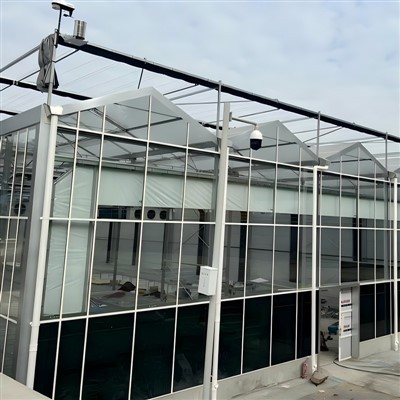

If you’ve ever stepped inside a commercial Venlo greenhouse on a hot summer day, you’ve likely noticed something striking: no matter which row of tomato plants, herb beds, or potted orchids you stand near, the temperature stays consistent, and that heavy, stuffy air you’d expect in a glass enclosure isn’t there. That’s not luck—it’s the precision-engineered air circulation pattern that makes Venlo greenhouses (unlike smaller, older greenhouse types) work reliably for large-scale, year-round cultivation. As a supplier of these structures, I’ve spent years refining how we integrate and optimize air flow in our Venlo designs, because it’s the secret to everything from disease prevention to even crop growth. Let’s break down how it all works, and why this circulation pattern is non-negotiable for commercial growers.
First, let’s ground ourselves in what makes a Venlo greenhouse different from other glasshouse styles, because that core structure directly shapes its air circulation. Unlike traditional gable greenhouses with a single sloped roof, Venlo designs are made up of multiple interconnected, equal-sized roof sections (called bays) that meet at rigid metal frames—usually hot-dip galvanized steel, for durability. This modular, grid-like structure is what allows growers to build large, custom facilities (sometimes spanning acres) without the risk of roof sag or structural gaps that would mess with air flow. You can learn more about the foundational Venlo build by checking out our Venlo Glass Greenhouse page, which details how the uniform roof bays and tempered glass panels create an enclosed space that’s predictable for air management.
The Venlo greenhouse’s air circulation pattern isn’t a single, static system—it’s a coordinated blend of passive and active flow, tailored to regulate temperature, humidity, and air quality in zones that often span thousands of square feet. Let’s start with the natural, passive components, because they form the base of circulation before any mechanical systems kick in. Glass is semi-transparent to short-wave solar radiation, meaning sunlight passes through the glass and warms the soil, plants, and air inside the greenhouse. When air near the soil surface heats up, it expands and becomes less dense, so it rises toward the roof. This is called the stack effect, and it’s the backbone of passive air flow in Venlo structures. Because of their modular, peak-roof design, Venlo greenhouses have built-in vents along the top of each roof bay (called ridge vents) and sometimes along the side walls (sidewall vents) that are strategically placed to vent that rising, hot air. When the pressure inside pushes warm air out through the ridge vents, cooler, denser air from outside is drawn in through the side vents, creating a continuous, natural loop. Of course, this passive system only works when outdoor conditions are mild—on 90°F summer days, or in cold winter months, growers can’t rely on stack effect alone. That’s where the active, mechanical circulation elements come in.
Active systems in a Venlo greenhouse’s air circulation pattern are designed to amplify and control the passive flow, eliminating dead zones—spots where hot, humid air gets trapped, or cold air pools at the floor. The most common active tools are exhaust fans, intake fans, and horizontal air flow (HAF) fans. Exhaust fans are usually mounted on one end wall of the greenhouse, pulling air out at a controlled rate, which creates negative pressure that draws fresh, filtered air in through intake vents on the opposite end. This cross ventilation pattern moves air evenly across the entire crop canopy, preventing the hot air pockets that would cause leaf scorch on sensitive plants like lettuce or basil. HAF fans are equally important, especially in large Venlo structures, because they keep that cross flow consistent even when crop height, plant density, or greenhouse size changes. Unlike exhaust fans, HAF fans run continuously at low speeds (usually 0.5 to 1 miles per hour at the canopy level, the sweet spot for most crops) to prevent stratification—when warm air sits at the roof and cold air sits near the floor, which is a common problem in tall Venlo bays.
One of the biggest benefits of the Venlo greenhouse’s air circulation pattern is its ability to handle humidity, which is critical for preventing fungal diseases like powdery mildew or botrytis. When plants transpire, they release water vapor into the air; without consistent air flow, that vapor can build up on leaf surfaces, creating the perfect environment for pathogens to grow. The combination of ridge vents, exhaust fans, and HAF fans keeps humidity levels in the target range (usually 60% to 80% for most greenhouse crops) by moving moist air away from leaves and venting excess moisture outside. In winter, when greenhouse vents might be closed to conserve heat, HAF fans are even more important—they mix the moist air at the canopy with drier air near the ceiling, then pull that moist air through dehumidification systems if needed, instead of letting it settle on plants.
Temperature regulation is another key function of Venlo-specific air circulation. Because Venlo structures are often used for year-round growing, growers need to adjust air flow for both heating and cooling. In the winter, when the greenhouse is heated via boilers or hot air systems, the circulation pattern works to distribute that heated air evenly. HAF fans blow warm air away from the heating ducts (usually mounted near the roof) down to the crop level, preventing the common “hot roof, cold floor” issue that wastes energy and stunts root growth. In the summer, when temperatures rise, the cross ventilation from exhaust and intake fans, paired with pad-and-fog cooling systems that add cool, moist air to the incoming air stream, works with the stack effect to pull hot air out quickly. The modular roof design of Venlo structures also lets growers adjust individual ridge vents per bay, so they can fine-tune air flow for different crop zones—for example, venting more from the bay holding heat-loving tomatoes and less from the bay holding cool-weather spinach.
As a supplier, we’ve seen how small adjustments to Venlo greenhouse air circulation can make a huge difference for growers. For example, a 2022 study of 50 commercial Venlo tomato greenhouses in the Netherlands found that optimizing HAF fan placement to match crop row spacing reduced leaf disease incidence by 35% and increased yield by 12% compared to greenhouses with generic circulation systems. That’s why we don’t just sell Venlo Style Greenhouse structures—we work with growers to design the entire circulation system from the ground up, factoring in crop type, growing zone, energy costs, and long-term maintenance needs. Our Venlo greenhouse models, like the VeGalvanized Venlo Glass Greenhouse: Insulated Tempered Glass Structure for Commercial Cultivation, are built with integrated vent rails that fit standard ventilation equipment, plus pre-planned mounting points for HAF fans, so growers don’t have to modify the structure later to get consistent air flow.
Of course, like any system, Venlo greenhouse air circulation has its limits, and modern designs address those with smart technology. Many growers now use climate control sensors that monitor temperature, humidity, and CO2 levels at multiple points across the greenhouse, and adjust fans, vents, and exhaust rates automatically. For example, if a sensor detects that humidity in the lettuce zone is climbing above 80%, it can open the corresponding ridge vent and ramp up the HAF fans in that specific bay, without disturbing the tomato zone. This level of precision is what makes Venlo greenhouses ideal for high-value crops like orchids, cannabis, or specialty herbs, where even small changes in air quality can impact crop quality and profitability.
If you’re a grower considering expanding or upgrading to a Venlo greenhouse, understanding the air circulation pattern is key to maximizing your investment. Unlike smaller, standalone greenhouses that rely on basic venting, Venlo structures are designed to support large-scale, controlled growing, and their circulation system is at the heart of that functionality. Whether you’re growing for local grocery stores or exporting crops across borders, a well-designed air flow system will reduce disease, cut energy costs, and help you get more consistent, higher-quality harvests year-round.
If you have questions about how a Venlo greenhouse’s air circulation pattern would work for your specific crop or growing goals, or want to learn more about our Venlo structure designs, get in touch with our team today to discuss your needs. We’ll walk you through the process of designing a circulation system tailored to your operation, so you can get the most out of your investment.
References


- Van der Linden, L., et al. (2022). Air circulation optimization in commercial Venlo greenhouses: Impacts on crop yield and disease incidence. Acta Horticulturae, 1349, 217-224.
- Gruda, N. (2019). Modern greenhouse systems for sustainable food production. Frontiers in Plant Science, 10, 1234.
- Gauthier, L., et al. (2021). Passive and active air flow dynamics in Venlo-style glass greenhouses: A comparative analysis. Biosystems Engineering, 209, 112-125.